


Metro Vancouver Residential Market Report Jan 2025
In January 2025, the Metro Vancouver housing market saw a significant increase in new listings, with a 46% jump compared to the same month last year. This eagerness from sellers to enter the market at the start of the year resulted in 5,566 newly listed detached, attached, and apartment properties on the MLS®. This figure is also 31.1% higher than the 10-year seasonal average.
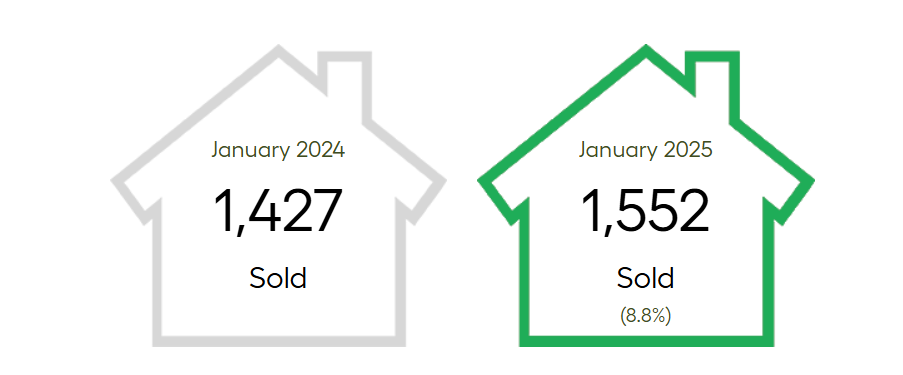
Despite the surge in new listings, residential sales also experienced an uptick. A total of 1,552 homes were sold in January 2025, marking an 8.8% increase from the 1,427 sales in January 2024. However, this sales figure remained 11.3% below the 10-year seasonal average of 1,749.
The total number of properties available for sale in Metro Vancouver reached 11,494 by the end of January 2025, a substantial 33.1% increase compared to the 8,633 listings in January 2024. This inventory level is also 33.2% above the 10-year seasonal average of 8,632.
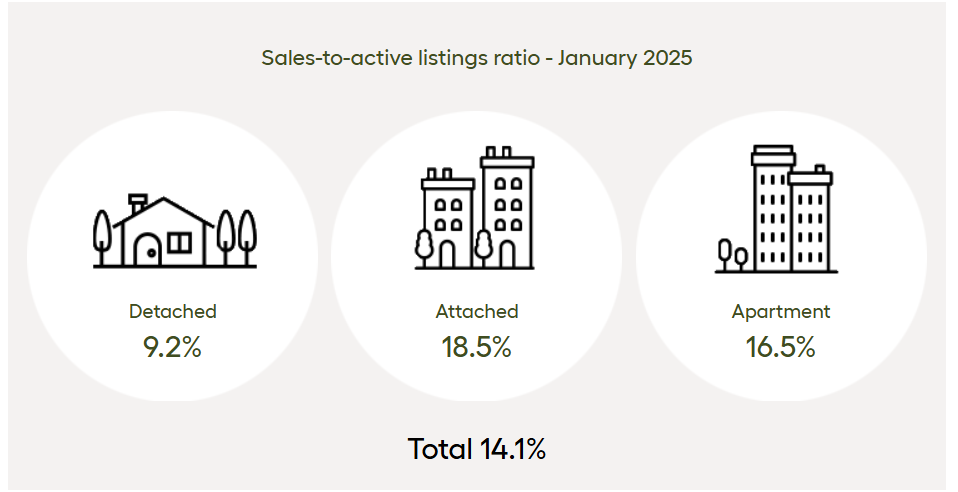
The sales-to-active listings ratio for January 2025 stood at 14.1% across all property types. When broken down by type, the ratio was 9.2% for detached homes, 18.5% for attached homes, and 16.5% for apartments. Historically, a ratio below 12% for a sustained period suggests potential downward pressure on prices, while a ratio above 20% over several months can indicate upward pressure.
Source: GVRealtors
According to Lis, the balanced conditions in January, with new listings exceeding demand, led to minimal price fluctuations across different housing segments. While a moderate price growth is anticipated for the end of 2025, potential economic shocks, such as US tariffs, could impact this forecast. The actual implementation and duration of these tariffs, along with Canada’s response, will determine their effect on the regional housing market in the coming months.
The MLS® Home Price Index composite benchmark price for all residential properties in Metro Vancouver was $1,174,400 in January 2025. This represents a modest 0.7% increase from January 2024 and a 0.2% increase compared to December 2024.
Looking at specific property types:
- Detached homes: Sales reached 380, a slight 0.3% increase from the previous year. The benchmark price was $2,010,100, showing a 3.4% year-over-year increase and a 0.7% increase from December 2024.
- Apartment homes: Sales saw a significant 13.4% increase to 846 units. The benchmark price was $748,100, representing a 1.7% decrease from January 2024 and a 0.2% decrease compared to the previous month.
- Attached homes: Sales rose by 12.6% to 321 units. The benchmark price for townhouses was $1,105,600, indicating a 2.7% increase from the previous year but a 0.8% decrease compared to December 2024.
Correction Regarding HPI Calculation: It was later reported on March 20, 2025, that a technical error affected the Home Price Index (HPI) calculation for January and February. While all areas were impacted, smaller, lower-volume regions were primarily affected. Other statistics like sales and listings remained accurate. The February data has been corrected, and the updated January data is expected soon.
*The Metro Vancouver area, as defined by Greater Vancouver REALTORS®, includes Bowen Island, Burnaby, Coquitlam, Maple Ridge, New Westminster, North Vancouver, Pitt Meadows, Port Coquitlam, Port Moody, Richmond, South Delta, Squamish, Sunshine Coast, Vancouver, West Vancouver, and Whistler.
In conclusion, Andrew Lis, GVR director of economics and data analytics, observed a shift in the Metro Vancouver housing market dynamics heading into the new year. While buyer demand had been gaining momentum in the preceding three months, the start of the year saw a shift towards sellers, evidenced by increased new listing activity. Despite this surge in listings, sales continued to surpass the previous year’s figures, indicating that buyer appetite remained following the market’s upward trend at the close of 2024. This suggests a market where both sellers were actively entering, and buyers were still present, albeit with a potential shift in leverage towards sellers due to the increased inventory.
